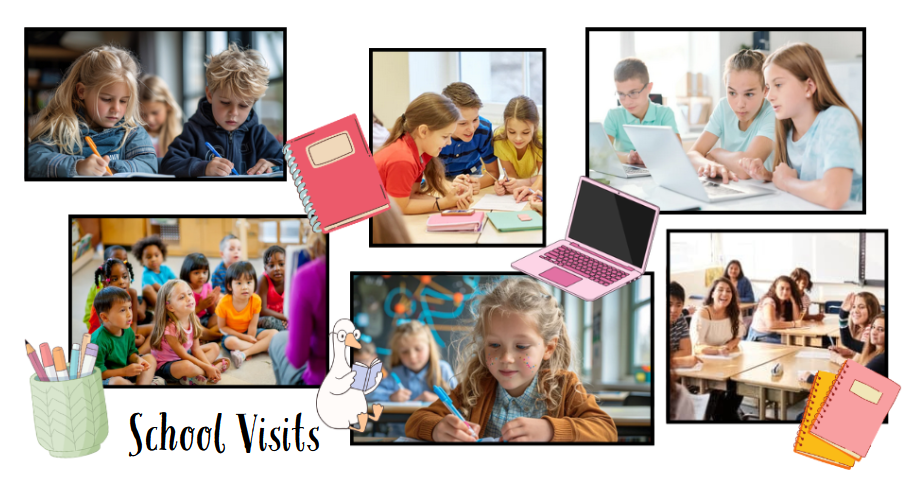
Like many, or even most authors who write for children and teens, I love to visit schools to talk about my books and present writing workshops, but how does having an author like me come in add value to learning?
There are so many answers to that about engagement and boosting literacy skills. You’ve heard them before, or can guess what they are. Meeting the author and hearing their story about the story brings books to life for children (and adults, too!)
The real magic happens for students when their creativity is sparked, growing their confidence and helping them to engage enthusiastically with the written word as young readers and writers.
I’m always happy to work with teachers and schools to come up with a bespoke workshop or presentation, but here a few options that might suggest some ideas:
Short and Sweet
(45 minutes to 1 hour)
Meet the Author: A Chat with Cate
Suitable for all year groups, this session can be tailored to match your group. I will give a little bit of information about myself (and the hows and whys of becoming an author) and my books (or a specific book) and then open the floor to (pre-prepared) questions from the students about the writing life &/or my book(s).
Try my Millie books for friendship and kindness or Starberries and Kee for sustainability and climate change (and adventures in a solar-punk climate-fic genre)
About a Book: Creative Process
Primary & Middle School
This short presentation focuses on the process of creating a book from the initial idea to being publication-ready. I focus on my own process but explain about how this differs from author to author.
Immersive Workshops
(2-3 hours)

Playing With Words: Getting Creative
This workshop which can be adapted for Upper Primary and Secondary Students takes a look at what is meant by creativity and invites participants to become familiar with the unfamiliar as they respond to prompts to plat with words.
Magic Box: Getting Creative 2
The Magic Box builds on from the Playing With Words Workshop, and invites participants to emphasise the creative over the correct when working on a first draft or developing ideas.
Together, the two Getting Creative workshops can be combined to create a full day of learning or two consecutive days.

Chasing Dreams: Where do you get your ideas?
This workshop looks at how ideas can be elusive even when we have a prompt to guide us, and offers practical strategies for fun ways to find and harness ideas. Ideal for upper primary and secondary but can be personalised for younger students.
Knowing Where You’re Going: The perfect plan
The irony is that there are many ways to plan, and none of them are perfect for everyone How do you find out what works for you? Here are some ideas that could change the way you write forever. Good for middle and upper primary, but flexible enough to appeal to secondary, too.
Knock, knock. Who’s There? Knowing who you are writing for
Perfect for confident writers who are starting to think about their audience and what works for who, this workshop is better suited to Upper Primary but works well with younger students who have a flair for stories.

What a Character: Bringing your characters to life
Sometimes our characters leap off the page and almost seem like a person we know, and other times they feel flat, with no life at all. In this workshop we explore what makes all the difference and how we can help our readers get to know the characters in our stories.
Welcome to My World: Thinking about setting
Part of making any story successful is bringing the reader into the world that your characters inhabit – and it is so much more than just a place. How do we make readers feel like they are there? What are all the elements of setting? How can we truly describe the world that we are imagining?
Crossing the Finishing Line: How do you end your story?
We often spend a lot of time thinking about how to begin our story, but tying everything up neatly is also a skill that deserves a bit of extra thought. This workshop for middle and upper primary looks at the different ways we can end stories and how to use that to our advantage.
Through the Portal 1: Building a Fantasy World
From magical realism to epic fantasy, the story often rests on how real an unreal world feels. In building a fantasy world we create something that feels different but is built on the familiar, taking rules and turning them upside down. To work, it has to draw the reader in, feel true, and take them on an adventure.
Through the Portal 2: Character Arc in Fantasy
Once you have made your world, it is time to put your people on the stage and set them in motion. In Fantasy, even more than in other forms of fiction, your character is on a journey, and the way they grow and develop is integral to the plot.
Combines with Through the Portal 1: Building a Fantasy World to create an intensive full day workshop for secondary students.
